Dual fuel range
Wolf dual fuel range repair
Sealed burners, infrared broilers and the electric oven cavity, diagnosed and repaired in your kitchen.
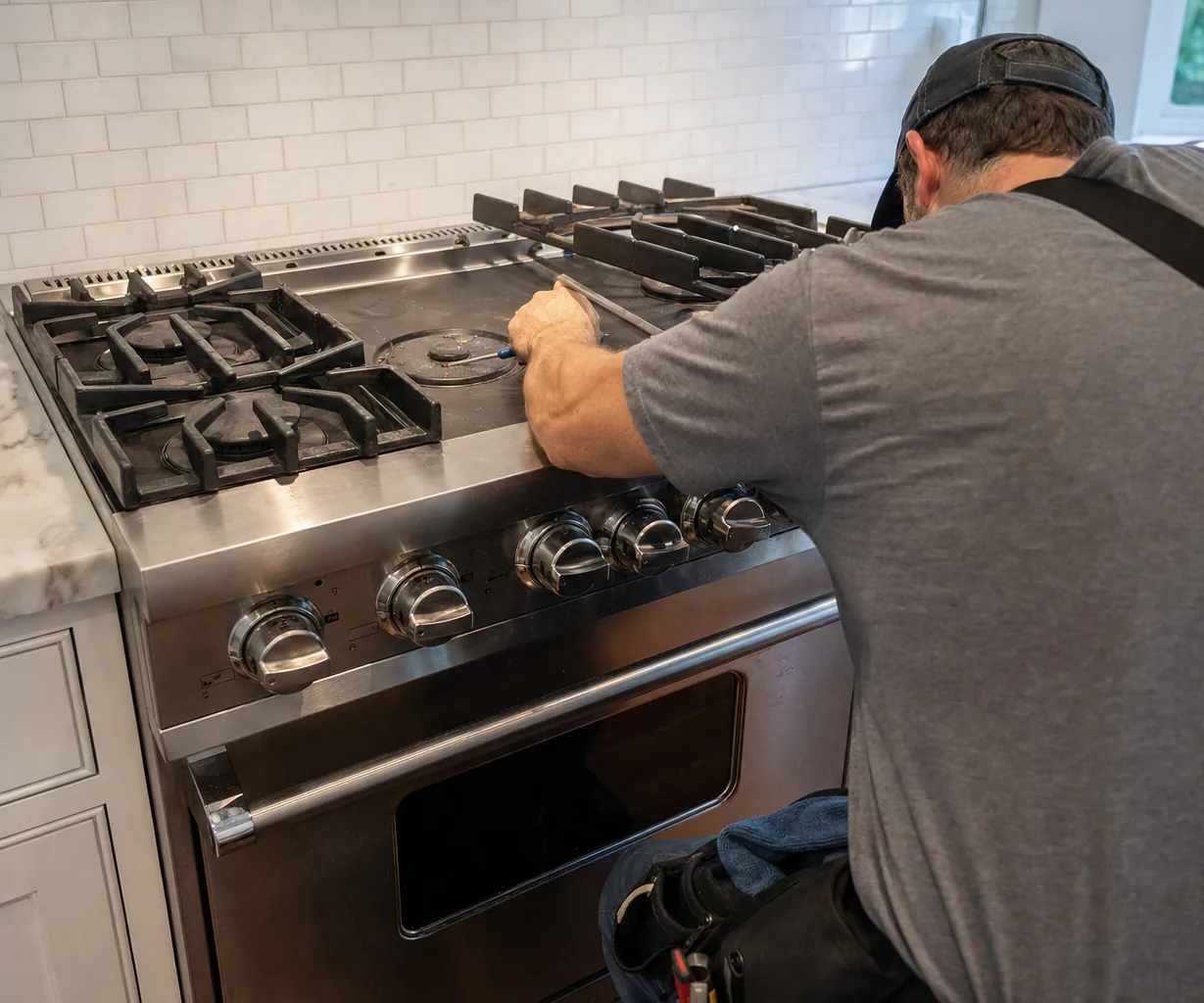
Symptoms
- A surface burner clicks but never lights
- Burner flame is yellow, lazy or lifting off the port
- The oven is not heating while the surface burners still light
- The oven runs cold, runs hot, or will not hold a set temperature
- The convection fan is noisy or has stopped turning
- The control panel is dark, frozen, or ignores button presses
Detail
A dual fuel range is two appliances sharing a chassis: gas on top, electric below. When something goes wrong the first useful question is which half.
Gas-side faults usually announce themselves. A burner that clicks forever without catching is almost always a fouled igniter tip or a blocked port, not a failed valve. A yellow, lazy flame points at the air shutter, the orifice, or gas pressure at the regulator. On the coast, spilled brine and salt-laden air corrode the spark electrode and its ceramic insulator faster than they do inland.
Electric-side faults are quieter. An oven that drifts out of calibration, a convection motor that starts to whine, a bake element that has gone open circuit. These get diagnosed with a meter, not by ear.
Why dual fuel is worth diagnosing properly
The appeal of dual fuel is that each half does what it is best at: gas gives you a flame you can read at a glance, and an electric cavity holds a temperature more steadily than a gas one because it is not cycling a burner to do it. The cost of that arrangement is two entirely different sets of failure modes sharing one control panel and one set of knobs.
That is why the same complaint — “it is not cooking right” — can mean four unrelated things. A cooktop that has lost its low end. An oven whose sensor has drifted. A convection fan that turns but no longer moves air past a food load. A door seal that has gone hard and is letting heat out at one hinge corner.
Guessing between those is expensive. Measuring between them takes twenty minutes.
The oven, measured rather than judged
A single thermometer reading proves very little. Ovens overshoot on the way up and undershoot on the way back, and that is normal behaviour, not a fault.
What we do instead is log a full cycle at two different setpoints and look at the shape of the error. A constant offset across both is a calibration job. An error that grows with temperature is a sensor or a harness connection that has picked up resistance. An error that only appears with a load in the cavity is usually airflow — the convection fan, or a shelf arrangement blocking the return.
Calibration drift is not a defect
Sensors move over years. Every oven does it. The reason it feels sudden is that nobody notices a five-degree drift, and then one day a recipe that has always worked does not, and the drift has quietly reached twenty.
If yours is out by a consistent amount at every setting, that is a short visit and a small bill.
The convection fan
A convection fan bearing lives hot and survives the temperature swing of every self-clean cycle. Noise is the early warning and it follows a pattern: a faint rumble, then a rattle, then a rising whine at all speeds. If the noise started shortly after a clean cycle, that is not a coincidence.
A fan that has stopped moving air while still turning is the harder version, because nothing sounds wrong. It shows up as convection that no longer makes a difference, which owners tend to describe as a change in their own cooking.
What a visit looks like
We start with the flat diagnostic fee, which is credited toward the repair if you go ahead. You get the fault, the part, the price and the lead time in writing before anything is ordered.
Parts are genuine OEM. Warranty terms are listed in the footer of every page and on the rates page.
Where this comes up
- Ponte Vedra Beach32082
The rest of the work
- Wolf gas range repairGas range
- Wolf rangetop and cooktop repairRangetop or cooktop
- Wolf built-in wall oven repairBuilt-in wall oven
- Wolf convection steam oven repairConvection steam oven
- Wolf hood, blower and downdraft repairVentilation hood
- Wolf built-in outdoor grill repairBuilt-in outdoor grill
Booking
Flat $80 diagnostic, credited toward the repair when you go ahead with it. You get a written estimate before any part is ordered or any labour is billed. 90 days on labour, 365 days on parts, genuine OEM parts only.
+1 (904) 201-3304After a dual fuel range call
4.6
out of 5, across 67 customer reviews. Each one below is a single visit, written by the person who paid for it.
The repair worked and the man who came was careful and pleasant. My frustration was the cost of the part, which I only learned about after the estimate, and it took three calls to get that settled.
Ferdinand Z.
The oven side of our dual fuel would light and then drop out ten minutes later. He measured the flame sensor circuit, found the ground path corroded at the chassis and remade it. Solid ever since.
Serafina D.
The oven ran hot and everything came out dark underneath. He recalibrated it and replaced a tired sensor. Fixed, but I wish the first visit had looked at the sensor instead of only the calibration.
Beatrix O.
The book
What does this repair cost?
$80
Flat $80 diagnostic covering the visit and the full diagnostic sequence, credited toward the repair once you approve the work. Everything under it is a band, not a quote. The figure that counts is written down after the diagnosis, and it covers the part, the labour to fit it, and the warranty — 90 days on labour, 365 days on parts, genuine OEM parts only.
| What was wrong | Typical finished repair |
|---|---|
| Diagnostic visit on its own | $80, credited |
| Oven thermostat or temperature sensor | $170–$530 |
| Convection fan or motor | $260–$730 |
| Control board or touch panel | $420–$1,070 |
| Igniter or spark module replacement | $190–$540 |
Those are the bands this page's faults land in; the rest of the book is on the rates page. The top of them is $1,070, and nothing at all — at that figure or well under it — is billed without a written estimate you have agreed to first.
Asked on the phone
What else do people ask?
- Why does a burner click and click without catching?
- Almost always the spark electrode or the module driving it: a cracked ceramic, a fouled tip, or a boil-over that has bridged the gap. A cap sitting a degree out of its seat will do it too, and that costs nothing to correct. Replacing the igniter or the spark module runs $190–$540.
- Why is the oven running cold or taking an age to preheat?
- Either the sensor is reading wrong or the element is not making the heat it claims. A probe on the rack at three settings separates the two inside a quarter of an hour. A sensor or thermostat replacement falls in $170–$530; a calibration trim on a sound oven is part of the visit.
- A blower has started to growl. Can it wait?
- On this coast that growl is usually salt in the bearings, and a bearing caught while it still turns is a far smaller job than a seized motor and a scorched winding. Fan and motor work sits at $260–$730. Bring it forward rather than waiting for it to stop.
- What does a visit cost?
- Flat $80 diagnostic, credited toward the repair when you go ahead with it. You get a written estimate before any part is ordered or any labour is billed. There is no separate travel charge inside the 40-mile radius.