Gas range
Wolf gas range repair
Sealed dual-stacked burners, the infrared broiler and the gas oven cavity, diagnosed in your kitchen rather than guessed at over the phone.
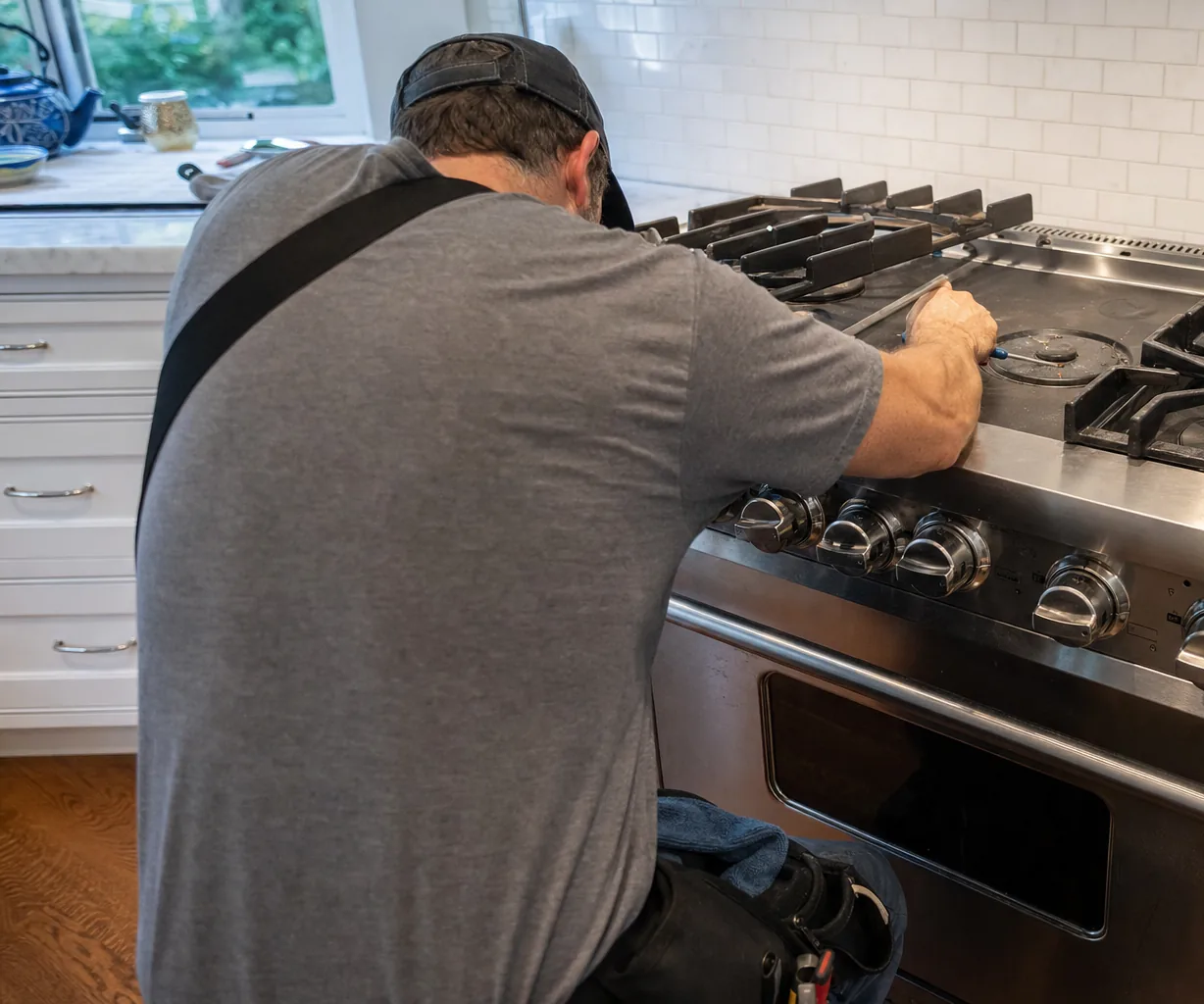
Symptoms
- A burner clicks and clicks but never catches
- All burners spark at once when only one knob is turned
- Flame is yellow, lifting off the port, or uneven around the ring
- The simmer setting will not hold and drops out to nothing
- The infrared broiler glows on one side only
- The oven is not heating although every burner lights
- Oven temperature drifts high or low over a long bake
- A burnt or gassy smell that clears once the hood runs
Detail
An all-gas range has fewer failure modes than a dual fuel one, and they are mostly mechanical. That is good news. Mechanical faults are visible, repeatable and cheap to confirm.
The burners
Wolf surface burners are sealed and dual-stacked, which means one burner head carries two separate flame rings fed through the same valve. The upper ring does the work at high output. The lower ring is what gives a real simmer without cycling.
When a burner will not light, the order of suspicion almost never changes. First the igniter tip, which fouls with boil-over residue and, on this coast, with a fine salt film that survives wiping. Second the burner ports, which clog from the outside in. Third the spark module, which is the only electrical part in the chain. The valve itself is last, and it is rarely the answer.
A burner that lights but burns yellow and lazy is a different fault entirely. Yellow means the air-to-gas ratio is wrong: a shifted burner cap, a blocked air shutter, a partly obstructed orifice, or supply pressure that is off at the regulator. It is not a sign the range is worn out.
If every igniter sparks when you turn one knob, that is normal on a spark module with re-ignition. If every igniter sparks continuously with all knobs off, one switch is stuck closed or wet, and that is worth fixing quickly — it is a small fault that eats the module.
The infrared broiler
The infrared broiler is a ceramic burner that has to come up to an even glow across its whole face. When one half glows and the other does not, the cause is usually gas distribution inside the burner rather than the burner surface. Dark patches in the ceramic, cracks, or a face that has been hit by a spill are harder news, because the element is not something you clean back to health.
We test a broiler by watching the whole warm-up, not by looking at it once. A burner that comes up evenly and then goes patchy is telling you something different from one that starts patchy.
The oven cavity
Gas ovens drift. A single measurement proves nothing, so we log the cycle: how long the burner runs, how far the cavity overshoots, how far it falls before the burner comes back, and whether the pattern holds over three or four cycles. That curve tells you whether you have a sensor reading wrong, a burner that is not making full output, a convection fan that has stopped moving air, or a door seal that is letting the heat out at the hinge corner.
Door gaskets are worth a mention on their own. A gasket that has taken heat for years goes hard and stops filling the gap. The oven still works. It just works harder, runs hotter at the top of the cavity, and cooks unevenly in a way that gets blamed on the recipe.
Salt, on a gas range
Coastal air does not attack the gas train. It attacks the electrical parts bolted next to it: spark electrodes, their ceramic insulators, the harness terminals at the module, and the flame-sensing circuit where the range has one. A house within sight of the dune line will go through electrodes faster than a house four miles inland with identical equipment and identical use.
What a visit looks like
Flat diagnostic fee, credited toward the repair when you go ahead. You get the fault, the part number, the price and the lead time in writing before anything is ordered. Parts are genuine OEM. Warranty terms are on the rates page and in the footer of every page.
One trade
Where the trade stops
We are a kitchen trade. The hood is where it ends: we repair the blower, the controls, the speed switch and the connection at the hood itself, and we will tell you when a duct run is the reason a kitchen will not clear. Installing, replacing or cleaning the ducting of a house is somebody else’s work, and so is anything to do with heating or air conditioning. If that is what you need, we would rather say so on the phone than send a van that cannot help.
We repair
- Ranges, rangetops and cooktops
- Built-in wall ovens and convection steam ovens
- Ventilation hoods, their blowers, controls and the hood end of the duct
- Built-in outdoor gas grills
We do not
- Heating, furnaces and heat pumps
- Air conditioning, and the ductwork that serves it
- Duct installation, duct replacement and duct cleaning anywhere in the house
- Refrigeration, dishwashers and laundry
Where this comes up
- Ponte Vedra Beach32082
- Marsh Landing32082
- The Plantation32082
- Palm Valley32082
The rest of the work
- Wolf dual fuel range repairDual fuel range
- Wolf rangetop and cooktop repairRangetop or cooktop
- Wolf built-in wall oven repairBuilt-in wall oven
- Wolf convection steam oven repairConvection steam oven
- Wolf hood, blower and downdraft repairVentilation hood
- Wolf built-in outdoor grill repairBuilt-in outdoor grill
Booking
Flat $80 diagnostic, credited toward the repair when you go ahead with it. You get a written estimate before any part is ordered or any labour is billed. 90 days on labour, 365 days on parts, genuine OEM parts only.
+1 (904) 201-3304After a gas range call
4.6
out of 5, across 67 customer reviews. Each one below is a single visit, written by the person who paid for it.
The oven burner cycled on and off far too often and food cooked unevenly. He replaced the sensor and repositioned it away from the wall, where somebody had bent it in against the liner. Even results now.
Valentina K.
There was a faint gas smell whenever the oven was lit. He soap-tested every joint, found a weeping flare at the manifold and remade it properly. He would not leave until the reading held steady.
Anatole M.
One burner would light only if you held the knob down for ages. He changed the spark module, which had a cracked case letting damp in, and reset the electrode gaps on all of them while he was there.
Rosamund I.
The book
What does this repair cost?
$80
Flat $80 diagnostic covering the visit and the full diagnostic sequence, credited toward the repair once you approve the work. Everything under it is a band, not a quote. The figure that counts is written down after the diagnosis, and it covers the part, the labour to fit it, and the warranty — 90 days on labour, 365 days on parts, genuine OEM parts only.
| What was wrong | Typical finished repair |
|---|---|
| Diagnostic visit on its own | $80, credited |
| Oven thermostat or temperature sensor | $170–$530 |
| Igniter or spark module replacement | $190–$540 |
| Burner valve or orifice service | $220–$710 |
Those are the bands this page's faults land in; the rest of the book is on the rates page. The top of them is $710, and nothing at all — at that figure or well under it — is billed without a written estimate you have agreed to first.
Asked on the phone
What else do people ask?
- Why does a burner click and click without catching?
- Almost always the spark electrode or the module driving it: a cracked ceramic, a fouled tip, or a boil-over that has bridged the gap. A cap sitting a degree out of its seat will do it too, and that costs nothing to correct. Replacing the igniter or the spark module runs $190–$540.
- Why is the oven running cold or taking an age to preheat?
- Either the sensor is reading wrong or the element is not making the heat it claims. A probe on the rack at three settings separates the two inside a quarter of an hour. A sensor or thermostat replacement falls in $170–$530; a calibration trim on a sound oven is part of the visit.
- A blower has started to growl. Can it wait?
- On this coast that growl is usually salt in the bearings, and a bearing caught while it still turns is a far smaller job than a seized motor and a scorched winding. Fan and motor work sits at $260–$730. Bring it forward rather than waiting for it to stop.
- What does a visit cost?
- Flat $80 diagnostic, credited toward the repair when you go ahead with it. You get a written estimate before any part is ordered or any labour is billed. There is no separate travel charge inside the 40-mile radius.